

The latest news stories across the state of Oregon from the digital home of the Oregon coastal cities, OregonBeachMagazine.com
Wednesday, May 13, 2026
Oregon Beach Weather



Here’s the overview of our weather outlook, but be sure to check out what we’re predicting in your area: https://www.farmersalmanac.com/extended-forecast

Rhododendron Festival Kicks Off in Florence

The 119th Rhododendron Festival begins Thursday, marking Oregon’s largest annual event and one of the state’s longest-running floral festivals.
The four-day celebration will draw thousands of visitors to enjoy parades, carnival rides, live entertainment, classic cars and more arts, crafts and shopping than you can possibly handle. Much of the festival takes place in Old Town by the river.
This year’s theme is “Tee-Moo Hee-Such, Hi.” Translated, it means “A Gathering With a Good Heart,” gifted by the Confederated Tribes of Coos, Lower Umpqua and Siuslaw Indians.
Activities begin Thursday as Davis Shows Carnival opens for four days of rides and games. Festival events include the Old Town Vendor Fair, Rhody Days Arts Festival, Rhody Run and Walk, the Rhododendron Show at the Florence Events Center, and the Classic Car Show ‘n’ Shine at its new Highway 101 and 21st Street location. Saturday night the Coast Radio Classic Car Cruise will rumble through Old Town at 5:30.
Florence’s Rhody Cruisers Car Club is bringing back the annual Rhody Days Car Show and Shine on Saturday, May 16th to the Grocery Outlet parking lot on Highway 101 and 21st Street.
Pre-registration runs through April 30th for $25, which includes a goody bag, while day-of-show registration is $30. Organizers say the event will feature classic cars, raffles, food trucks, music, and a Habitat for Humanity Poker Walk. Activities run from 8 a.m. to 2 p.m., with $5 tickets available for participants to join Coast Radio’s Car Cruise later that evening at 5:30.
The celebration wraps up Sunday with the Grand Floral Parade through Historic Old Town Florence.

DISASTER RESPONSE EXERCISE PLANNED FOR MAY 15 AND 16
– For the first time, Samaritan Pacific Communities Hospital and Lincoln County Emergency Management will co-host the Oregon Health Authority-sponsored Pathfinder exercise. This full-scale mass casualty disaster response exercise is planned for May 15-16. This event is closed to the public and only registered participants can attend. More than 100 military members, medical personnel, student nurses, and civilians will participate in this annual Oregon training event.
“This full-scale exercise simulates a catastrophic Cascadia Subduction Zone earthquake and tsunami. It focuses on the critical window when coastal communities are isolated, overwhelmed, and operating with severely limited infrastructure,” said Dr. Eric Gebbie, Director of Emergency Operations, Oregon Health Authority (OHA).
“It’s important during a crisis that all agencies understand and use a common language, align communications technologies, and build shared processes to strengthen coordination,” said Dr. Gebbie. “It takes practice to make that happen. This exercise brings together hospital, local, state, and federal partners to do just that.”
The drill begins on Friday afternoon with lecture-based training for participants at the Samaritan Center for Health Education. Early Saturday morning, community members who have volunteered to be pretend victims will arrive at the center to receive their assignments and moulage – special effects makeup depicting injuries. The training will extend into clinical areas of the hospital (where patients are not seen on weekends), so Emergency Department staff can train on the triage process, skills, patient flows and tracking.
“My staff will take turns participating in the training, so there will be no impact on care given to actual emergency patients we may have at that time,” said Pamela Halbrook, Samaritan’s regional Emergency Services Manager. “We’re excited to have this opportunity for hands-on training that will sharpen our skills and help us be a more cohesive team when the need arises.”
Local participants in the exercise include Lincoln County first responders, Samaritan Pacific Communities Hospital, Lincoln County Emergency Management, City of Newport, Lincoln County Public Health, U.S. Coast Guard, National Oceanic and Atmospheric Administration, and Life Flight Network. State participants include Oregon Disaster Medical Team, OHA’s Health Security Preparedness and Response program staff and SERV-OR volunteers, Oregon National Guard, Salem Hospital, and Oregon Health & Sciences University.
OHA leveraged $25,000 of its funding through the U.S. Health and Human Services Public Health Emergency Preparedness Program to pay for the exercise. This, along with the federal Healthcare Preparedness Program, provides states, counties, and hospitals with resources to support disaster preparedness activities. Activities covered by the funds include planning, training, and exercising.
While local, state, and federal partners gather to practice response, this gives communities another reminder of the importance of personal preparedness. Take time today to review your family emergency plan or check items in your emergency kit. Learn more about how to be Four Week Coastal Cascadia Ready at our website: https://www.co.lincoln.or.us/790/Plan-Prepare

10 a.m. – 4 p.m.
7755 US-101, Gleneden Beach,


The Oregon Department of Fish and Wildlife Invites Public Comment on Future of the State’s Commercial Dungeness Crab Fishery- 1 More Meeting This Week on Thursday 5/14
The Oregon Department of Fish and Wildlife is hosting three public meetings along the coast to discuss the state’s commercial Dungeness crab fishery. Commercial fishermen, industry representatives and anyone interested in the fishery are encouraged to attend.
ODFW staff will give updates related to marine life entanglement including the draft conservation plan. Staff will ask for input on the following planned agenda items for the August 14 Fish and Wildlife Commission meeting: five-year risk reduction measures evaluation, electronic logbooks, and rulemaking for vessel monitoring and experimental fishing gear permits.
All meetings will have a virtual option using Microsoft Teams.
May 14, Astoria, (1-4 p.m.)
Astoria Public Library,
450 10th St.
Virtual option: click this link
Dial in using phone: +1 503-446-4951, Phone Conference ID: 587 262 054#
ODFW provides reasonable accommodation upon request, including assistive listening devices, sign language interpreters, and materials in large print or audiotape. To request accommodation, please contact the Marine Resources Program office at 541-867-4741 or fax 541-867-0311 at least 48 hours prior to the meeting.
An information booth at the Devil’s Churn Day Use Area is open Tuesday, Wednesday, Friday, and Saturday from 10am to 3pm. Cape Perpetua offers 26 miles of hiking trails through old‑growth forest, past tidepools, Native American shell middens, and iconic viewpoints including Devil’s Churn.
DISASTER RESPONSE EXERCISE PLANNED FOR MAY 15 AND 16
– For the first time, Samaritan Pacific Communities Hospital and Lincoln County Emergency Management will co-host the Oregon Health Authority-sponsored Pathfinder exercise. This full-scale mass casualty disaster response exercise is planned for May 15-16. This event is closed to the public and only registered participants can attend. More than 100 military members, medical personnel, student nurses, and civilians will participate in this annual Oregon training event.
“This full-scale exercise simulates a catastrophic Cascadia Subduction Zone earthquake and tsunami. It focuses on the critical window when coastal communities are isolated, overwhelmed, and operating with severely limited infrastructure,” said Dr. Eric Gebbie, Director of Emergency Operations, Oregon Health Authority (OHA).
“It’s important during a crisis that all agencies understand and use a common language, align communications technologies, and build shared processes to strengthen coordination,” said Dr. Gebbie. “It takes practice to make that happen. This exercise brings together hospital, local, state, and federal partners to do just that.”
The drill begins on Friday afternoon with lecture-based training for participants at the Samaritan Center for Health Education. Early Saturday morning, community members who have volunteered to be pretend victims will arrive at the center to receive their assignments and moulage – special effects makeup depicting injuries. The training will extend into clinical areas of the hospital (where patients are not seen on weekends), so Emergency Department staff can train on the triage process, skills, patient flows and tracking.
“My staff will take turns participating in the training, so there will be no impact on care given to actual emergency patients we may have at that time,” said Pamela Halbrook, Samaritan’s regional Emergency Services Manager. “We’re excited to have this opportunity for hands-on training that will sharpen our skills and help us be a more cohesive team when the need arises.”
Local participants in the exercise include Lincoln County first responders, Samaritan Pacific Communities Hospital, Lincoln County Emergency Management, City of Newport, Lincoln County Public Health, U.S. Coast Guard, National Oceanic and Atmospheric Administration, and Life Flight Network. State participants include Oregon Disaster Medical Team, OHA’s Health Security Preparedness and Response program staff and SERV-OR volunteers, Oregon National Guard, Salem Hospital, and Oregon Health & Sciences University.
OHA leveraged $25,000 of its funding through the U.S. Health and Human Services Public Health Emergency Preparedness Program to pay for the exercise. This, along with the federal Healthcare Preparedness Program, provides states, counties, and hospitals with resources to support disaster preparedness activities. Activities covered by the funds include planning, training, and exercising.
While local, state, and federal partners gather to practice response, this gives communities another reminder of the importance of personal preparedness. Take time today to review your family emergency plan or check items in your emergency kit. Learn more about how to be Four Week Coastal Cascadia Ready at our website: https://www.co.lincoln.or.us/790/Plan-Prepare

Lane County’s Land Management Division has opened a new satellite office in Florence to provide coastal residents with easier access to planning and building services.
The office will operate by appointment only on alternating Thursdays from 9:30 a.m. to 3 p.m. at Florence City Hall on Highway 101. County planning staff will be available to answer questions about zoning, environmental features, coastal overlays, and permit requirements before construction begins. Building staff can also help with questions involving building codes and sanitation requirements. Appointments can be scheduled online at LaneCountyOR.gov/LMDcoastbooking
Bandon School District accepted the resignations Monday of its superintendent, two school board members and nine other employees.
The wave of resignations follows a turbulent year at Bandon School District that included teacher departures, complaints against district leadership, an ongoing third-party investigation and escalating tensions between administrators, the teachers union and some community members.
Superintendent Shauna Schmerer submitted her 60-day notice after five years leading the district. In her resignation letter, Schmerer said she had been presented with other opportunities, but did not provide additional details in a follow-up email. Her resignation follows months of public controversy during which Schmerer said she faced slander and abuse.
The school board also accepted the resignations of Briana Hutchens and former Board Chair Angela Cardas, both of whom blamed the teachers’ union and community members for what they called negativity, hostility and toxicity in the district.
Several resignation letters and comments at Monday’s meeting referenced complaints filed this year against the superintendent and school board. The board has dismissed some complaints, sometimes without publicly stating a reason.
A third-party investigator continues reviewing other complaints, and the board expects a final report by the end of the school year.
The district is also waiting for a decision in an unfair labor practices complaint filed by the teachers union. A hearing with the state Employment Relations Board concluded in February.
Whale Strandings Along Coast
Jim Rice with the OMMSN, and it is confirmed a gray whale washed up last week in Coos Bay and now another Gray whale a few miles south of Umpqua South jetty. That’s a total 7 gray whales for Oregon. 18 for Washington. Cascadia Resesrch collective is on scene now doing a necropsy on the female gray whale in Long Beach.
Jim Rice is the stranding program manager for the Marine Mammal Institute at Oregon State University explained that gray whales forage for food during the summer when they are in the northern part of their migration, and when they migrate south to Mexico in the winter, they fast. If a whale did not put on enough body fat during the summer, it will have a hard time making the return trip north in the spring.
“The spring is often when we see a high mortality rate with gray whales, because they’re having a hard time making the return trip,” Rice said. “They’ve left the Arctic without as many food reserves and fat stored in their body to get them through that time period.” “The bottom line is these whales have been having a hard time finding enough to eat,” Rice said. “They depend on foraging in the Arctic Ocean, the Chukchi Sea, and the Bering Sea, and their normal food regime is in short supply.”
If you are combing the beaches and spot one, be sure to call the west coast marine mammals stranding network. Take photos and try to pin the location as accurately as possible. 1-866-767-6114.
Former Florence Hospital Sold
The former hospital property on 12th Street in Florence has been sold, and the new owners are considering future residential use of the site. In recent years, office space had been rented in the building, but more recently the property has been used as a temporary refuge for homeless individuals. There have also been reports of sewage seeping on the property, along with vehicle and recreational vehicle storage behind the building.
Following the close of the sale, several vehicles were moved to another property at Highway 126 and Quince Street. City of Florence officials say the situation involves private property, and there are currently no active code enforcement cases related to the site. The new owners have not submitted any land use or building permit applications to the city at this time. When applications are filed, they will be posted on the City of Florence website.
2026 Primary Election Ballots in the Mail

Statewide Primary Election – May 19, 2026
The voter registration deadline for the May Primary Election was April 28, 2026.
Ballots began mailing to active voters in Oregon on April 29, 2026.
- View Oregon voter qualification requirements and submit your registration form online.
- Registered voters may check their status, update their voter registration details, and see when they will be mailed a ballot for the upcoming election using MyVote.
- Ballots will not be mailed to voters with inactive status. If MyVote shows you are inactive, please update your registration using MyVote or contact your County Elections Office.
Election Day is May 19, 2026.
Election Day is the last day for a voter to return their ballot.
- County Elections Offices are open 7 am – 8 pm on Election Day.
- View our official Ballot Drop Box Locator to find drop box hours.
- Ballots that are mailed must be postmarked by Election Day.
Oregon Whale Sightings is a fun place to hear about and report cetaceans along our beautiful coastline.

https://www.facebook.com/groups/1176168644064352/
Puffin Season is Back on the Oregon Coast
The beautiful, beloved tufted puffins are expected back at Haystack Rock in Cannon Beach, where the 2026 Welcome the Puffins Celebration will take place from 7:30 a.m. to 10 a.m. April 18.
Friends of Haystack Rock · We have puffins!
Check out our website, Friendsofhaystackrock.org to see them live! We have our webcam zoomed in on a couple active burrows. Your best chance to see them is in the morning between 8 a.m. and 11 a.m.

Organized by the Haystack Rock Awareness Program and Friends of Haystack Rock, the free event will not only celebrate the return of the puffins to their Oregon nesting grounds but also give the public the chance to spy on the birds as well. Interpretive rangers will be on hand with binoculars and spotting scopes to help people safely observe the tufted puffins.
Florence Youth Police Academy
 Applications for the 2026 Florence Police Department Youth Police Academy are now available!
Meant for youth ages 14 to 18 interested in a career in law enforcement, first response, and government, the Youth Police Academy will run from June 22 to 27, 2026. Applications are due Friday, May 22. Scholarships are available.
For more information, visit https://www.ci.florence.or.us/Youth-Police-Academy.
Newport & South Beach, Oregon Community · The City of Newport Parks and Recreation · We want YOUR input, Newport!
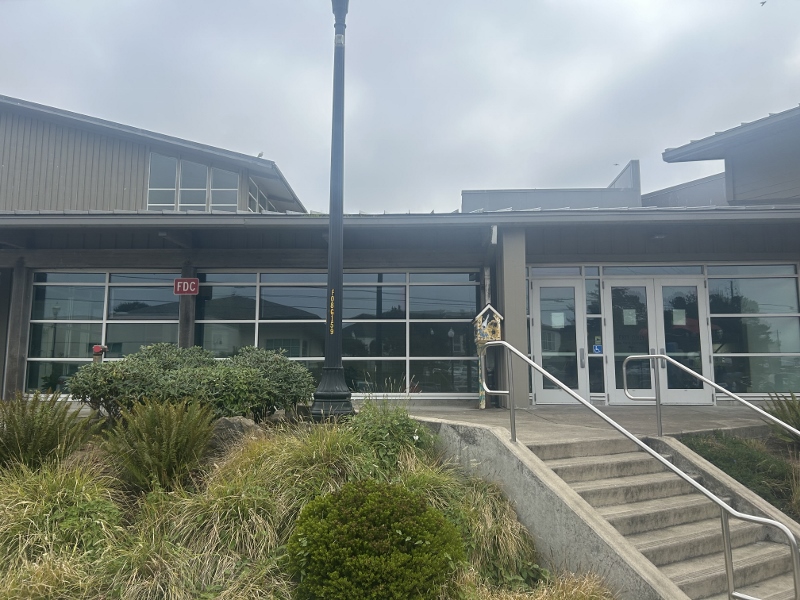
The Newport Recreation & Aquatic Center is getting a new look — and we’re asking the community to help design it! We’re creating new window wraps for the front of the Rec Center and want your ideas on the themes, activities, and imagery that best represent our community.
Take our short survey and make your voice heard!  https://www.surveymonkey.com/r/GMSBDH3The more responses we get, the better our design will be — so share this with your friends, family, and neighbors!
Respect Nesting Areas to Protect Threatened Snowy Plover Mar. 15 through Sept. 15

The Oregon Parks and Recreation Department and Siuslaw National Forest remind visitors to the Oregon Coast that western snowy plover nesting season begins March 15 and runs through Sept. 15.
Beachgoers can help recovery efforts for the threatened shorebird by observing recreation restrictions at designated plover beaches.
Sensitive plover nesting areas are identified on maps for the northern Oregon Coast and southern Oregon Coast. Western snowy plovers nest in dry sand above the high tide line and are often difficult to see because they camouflage well.
To help protect these tiny shorebirds, please stay on wet sand and leave your dogs at home or at your campsite, even if they are leashed. Visitors may notice signs at trailheads with additional rules and limitations. There may be rope fencing in dry sand areas; this fencing delineates some, but not all, of the critical plover habitat that should be avoided.
Seasonal recreation restrictions have helped protect and recover the western snowy plovers living on Oregon’s beaches. Nests, and especially chicks, are well-hidden. During the nesting season, human disturbances can flush adult plovers away from their nests as they attempt to defend their young. Left alone too long, or too often, eggs or chicks can die from exposure and predators. Habitat loss from invasive plants and human disturbances—including litter and discarded food scraps that attract predators— also contribute to the birds’ decline.
Recreation restrictions occur only in designated plover management areas where plovers nest or might nest. These areas combined make up about 40 miles of Oregon’s 362 miles of shoreline.
Reminders for recreation on designated plover beaches March 15 – Sept. 15:
- The following are not permitted: dogs (even on a leash), driving a vehicle, riding a bicycle or e-bike, camping, burning wood, flying kites or operating drones.
- Foot and equestrian traffic are permitted below the high-tide line on wet, hard packed sand.
- Respect signs and barriers to protect nesting habitat.
The U.S. Fish and Wildlife Service listed western snowy plovers as a threatened species in 1993 when officials counted only 45 breeding adults. Populations have steadily increased since then due to ongoing efforts. Officials counted 546 during the breeding season survey in 2025.
“We appreciate visitors’ support in keeping these shorebirds safe. We invite visitors to enjoy permitted recreation in sensitive areas or to recreate without seasonal restrictions on beaches not designated as plover nesting areas,” said Laurel Hillmann, ocean shore specialist for the Oregon Parks and Recreation Department.
More information on the snowy plover, including detailed maps of nesting sites, can be found on the Oregon State Parks website (oregon.gov/plovers) and on the Siuslaw National Forest website (fs.usda.gov/r06/siuslaw/animals-plants/western-snowy-plover).
Visitors to the Oregon Dunes National Recreation Area can review Off-highway Vehicle (OHV) maps to identify unrestricted recreation areas and information on riding motor vehicles on the sand at fs.usda.gov/r06/siuslaw/recreation/rules-and-guidelines.
Plover activity near Sand Lake Recreation Area — The increase in plover numbers may result in nesting occuring at new or historical nesting sites. For example, visitors to Sand Lake Recreation Area may see small roped off areas near the lake’s inlet to protect active nests and may encounter plovers on the beach. Beachgoers are encouraged to protect these birds by restricting recreation activities to wet sand areas, avoiding roped off nesting areas, packing all trash out and keeping dogs on leash. Paragliders should steer toward the northern area of Sand Lake Recreation Area to avoid gliding or landing near plover nests on the southern edge of the Sand Lake spit.
Background on plover protections — Several land managers oversee beach activity for plover protection, primarily the U.S. Forest Service (USFS), the Bureau of Land Management (BLM) and Oregon Parks and Recreation Department (OPRD). For more information on how plovers are managed in Oregon, see the Habitat Conservation Plan (HCP): https://www.oregon.gov/oprd/PCB/Documents/WSP-HCP_08182010-web.pdf.


Donor Offers $50K Reward in 40-Year-Old Case of Missing Oregon Coast Teen

Lincoln County authorities hope the recent offer from an anonymous donor of a $50,000 reward will lead to the remains of a 17-year-old Siletz girl who was last seen walking on U.S. 20 more than four decades ago.
An anonymous donor put up money hoping it will spur information that leads not only to Kelly Disney’s remains but also to the conviction of her killer, according to the Lincoln County District Attorney’s Office.
The DA’s Office has confirmed that an anonymous donor offered the reward for any information leading to Disney’s remains and/or the conviction of her killer.
Information can be submitted anonymously at 541-265-0669 or online at FindKellyDisney@co.lincoln.or.us
READ MORE on CASE: https://lincolnchronicle.org/15597-2/
Wildlife Center of the North Coast · We need your help!
Make a difference in wildlife rescue! Join our Wild at Heart Membership Program starting at just $5/month. Help us save lives!  https://coastwildlife.org/wild-at-heart/
It’s been a busy summer here at the Wildlife Center of the North Coast, and our rehab clinic has gone through lots of supplies caring for patients!!

->> To help us restock and stay prepared for the next wave of wildlife in need, we’ve updated our Amazon Wishlist with the items we need most. https://www.amazon.com/hz/wishlist/ls/LU97SQA0VPZA
Every donation—big or small—goes directly to helping orphaned, injured, and sick wildlife get a second chance at life. Check out our wishlist here: https://www.amazon.com/hz/wishlist/ls/LU97SQA0VPZA Thank you for being part of our wildlife rescue family!
Volunteers are being sought to help prepare and serve lunch three times a week at the Florence Senior and Activity Center.
They serve lunch Monday, Wednesday, and Friday each week. Both programs, the in-house dining known as Cafe 60, and Meals on Wheels, are very important in helping promote socialization and nutrition for older adults in Lane County. Volunteer drivers for Meals on Wheels use their own vehicles, but they can be reimbursed for their mileage. The Lane Council of Governments operates the Senior and Disabled Services in Lane County. Alisa Andrion encourages potential volunteers to give her a call at L-COG, 541-682-1366.
Gleneden Beach Community Club Events
Look what’s coming up soon at the Club… (sign up at glenedenbeach.org)
Emergency Volunteer Corps of Nehalem Bay

Follow on Facebook: Emergency Volunteer Corps of Nehalem Bay
Oregon Food Bank · Find free food sites near you using OregonFoodFinder.org.
If you can’t make it to a food location, someone else can pick up food for you.You will just need to print and fill out the Authorized Representative form at https://lnkd.in/dsskUpkQ, and have them take it with them to the food sites. You can find step-by-step instructions at https://lnkd.in/dVBRxn-A.
Worried about recent changes or losing assistance?
Here are resources that can help:
211Info: Dial 2-1-1 or visit the211Info food webpagefor information and referrals to more than 1,500 food resources across Oregon.
Oregon Food Bank: Use the Oregon Food Bank’s Food Finder Mapto find over 100 food pantries, free food markets or hot meal programs near you.
Aging and Disability Resource Connection of Oregon (ADRC): Call 855-673-2372 or visit theADRC food webpage to find local meal programs and food boxes in your area.

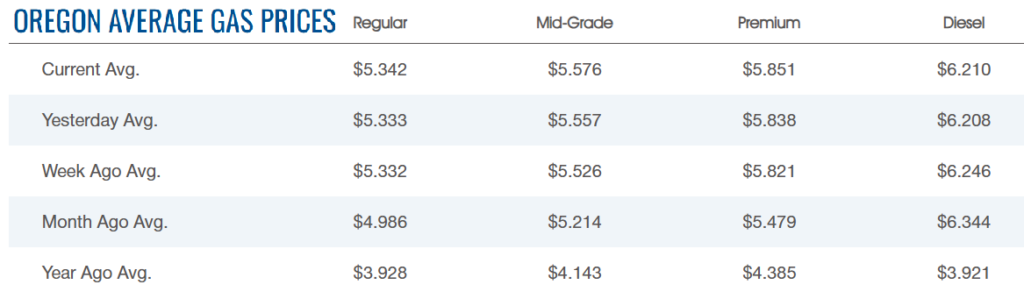
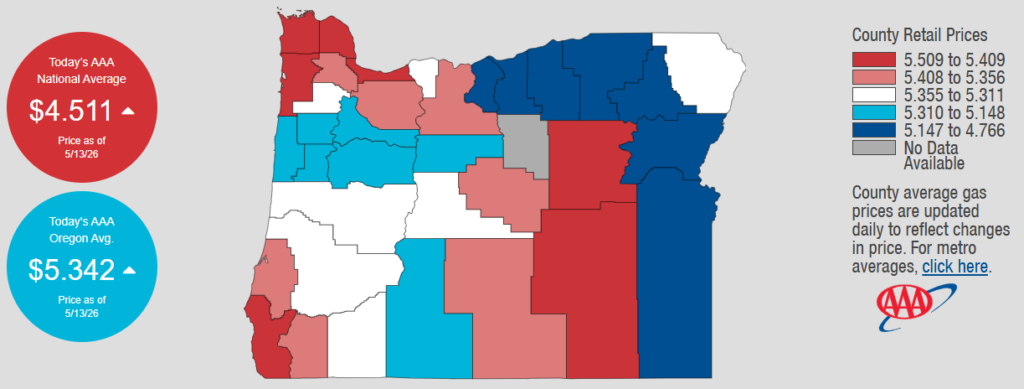
5/13/2026 — Gas Prices in Oregon Today


Simple weekend projects in the first five feet around your home can be crucial in determining whether you withstand a wildfire or face severe damage.
The Oregon State Fire Marshal urges residents to mark the beginning of Wildfire Awareness Month by undertaking at least one project focused on creating defensible space or enhancing home hardening this week.
Research from the Insurance Institute for Business & Home Safety indicates that minimizing combustible materials in this critical zone can greatly reduce the likelihood of a home igniting from wind-driven embers. As wildfire seasons grow longer and more severe, Oregonians can prepare by tackling these projects incrementally.
Start today by clearing leaves, pine needles, and other flammable debris from roofs, gutters, and decks to prevent ember ignition, covering vents with 1/8-inch metal wire mesh to block ember entry, relocating combustible items like furniture and trash cans at least five feet from the house, opting for gravel or pavers instead of bark mulch in the immediate vicinity, and maintaining lawns in a lean, clean, and green state during fire season.

Oregon Housing and Community Services earns higher credit rating – and that’s good news for housing across Oregon
Improved rating positions the state to lower borrowing costs and expand housing investments
— Moody’s Ratings – one of the world’s leading independent credit rating agencies – upgraded Oregon Housing and Community Services (OHCS’) issuer rating from A2 to A1. This upgrade places the agency among a strong tier of investment-grade housing finance agencies in the country and positions it to borrow money at a lower cost. That savings can then be reinvested into affordable housing programs – meaning more Oregonians served without spending more public money.
“Delivering housing solutions that make life better and more affordable requires delivering public excellence in agency operations,” said OHCS Executive Director Andrea Bell. “Receiving Moody’s strong A1 issuer rating reflects commitment to OHCS’ mission and accountability to the people of Oregon and the Legislature.”
The upgrade is a national recognition of OHCS’ strong financial management and reflects the agency’s ability to continue partnering with communities to finance affordable housing, support first-time homebuyers, and invest in housing stability efforts.
“When you pair prudent financial management with thoughtful program design, we can make taxpayer dollars go further,” Governor Tina Kotek said. “This even stronger credit rating will help us build more housing in all parts of the state.”
According to Moody’s, the improved rating is driven by the OHCS’ solid balance sheet strength and financial performance, which is expected to continue, speaking to the agency’s capacity to serve Oregonians over the long term.
“Oregon Housing and Community Services is to be commended for this vote of increased confidence based on the agency’s stellar management and strong results, which will bolster its ability to continue to serve the people of Oregon efficiently and effectively,” said Stockton Williams, executive director of the National Council of State Housing Agencies.
Credit quality is supported by OHCS’ strong loan portfolio, which consists primarily of loans held in the agency’s Single-Family Mortgage Revenue Bonds Program. Creditworthiness is further supported by OHCS’ conservative risk position, good risk governance, and a proactive management team.
The higher rating reflects outside confidence in OHCS’ ability to manage public resources responsibly and could also potentially reduce the agency’s cost of financing short-term bond obligations.
About Oregon Housing and Community Services (OHCS)
OHCS is Oregon’s housing finance agency. The state agency provides financial and program support to create and preserve opportunities for quality, affordable housing for Oregonians of low and moderate income. OHCS administers programs that provide housing stabilization. OHCS delivers these programs primarily through grants, contracts, and loan agreements with local partners and community-based providers. For more information, please visit: oregon.gov/ohcs.
Oregon Community Foundation Announces Building Hope Fund to Invest in Middle-Income Housing in Oregon

$100 million down payment designed to attract more financing to build homes
With Oregonians facing a severe housing shortage, Oregon Community Foundation is stepping up with a bold new commitment: A $100 million down payment to inspire even larger investments in Oregon housing.
Oregon Community Foundation President and CEO Lisa Mensah announced today the creation of the Building Hope Fund to provide loans to home builders across Oregon. The fund’s goal is to help finance 10,000 new housing units for middle-income Oregonians over 10 years.
The Building Hope Fund is a vehicle for impact investing. In addition to traditional grantmaking, impact investing is a powerful way to put capital to work to address the state’s most pressing issues. The Building Hope Fund will use Oregon Community Foundation’s investment capacity to provide flexible financing to developers who are ready to build homes for sale and rental housing across Oregon.
Oregon is currently building only about half of the 30,000 units needed every year to pull the state out of its housing crisis. The shortage is especially acute for housing designed for middle-income Oregonians.
“We hear it from business owners all the time: Jobs are sitting empty, and opportunities are unrealized because working families cannot find housing,” said Mensah. “We will invest in housing for middle-income Oregonians — restaurant servers, bartenders, nurses, small business owners, construction workers, teachers — and offer reasonable loans to developers so they can get busy building.”
Mensah said the Building Hope Fund will begin with $100 million in seed funding with the intention of bringing in other partners, including investors, donors, businesses, other foundations and financial institutions, to grow the fund and multiply its impact across rural and urban communities statewide.
“There’s a reason they call it the ‘missing middle,’” said Anna Mackay of Shortstack, a home builder in the Portland region. “Private capital builds market-rate housing; public funding supports deeply affordable homes. But middle-income housing falls through the gap. Home builders like us often have to piece together a dozen complicated funding sources for a single project. Oregon Community Foundation is paving the way. The Building Hope Fund is a galvanizing step toward housing more Oregonians.”
Union County homebuilder Gust Tsiatsos said that more remote areas like Eastern Oregon are overlooked by developers of large housing projects. Incomes are lower, and buyers have few options.
“We would like to reward and serve our working population by building more homes they can afford,” Tsiatsos said, adding that he has projects awaiting development in La Grande, Baker City and Ontario that could bring 67 homes to the region but are stuck for lack of affordable financing.
“Eight years ago, I could build for around $125 a square foot, and now we’re pushing $400 a square foot,” Tsiatsos said. “Affordable financing is one of the biggest challenges.”
Project Turnkey — Oregon Community Foundation has a strong track record in housing investments. After the pandemic and devastating wildfires in 2020, state leaders turned to OCF for Project Turnkey to quickly distribute $125 million in grants to convert underused motels into shelter and transitional housing. The initiative increased the state’s supply of emergency year-round shelter beds by 30 percent.
Oregon Impact Fund — Oregon Community Foundation will continue to operate the Oregon Impact Fund, a $33 million fund that lends to nonprofit organizations, tribal enterprises and for-profit social ventures in Oregon that create impact in affordable housing, education, health care access, natural resource management and job creation in underserved communities.
“Both Project Turnkey and the Oregon Impact Fund show what can happen when a foundation responds to a genuine crisis by adding to our traditional role as a grants-and-scholarships institution,” Mensah said.
Oregon Community Foundation will continue grantmaking to nonprofits throughout Oregon, including working in partnership with organizations building affordable housing and addressing homelessness. The Building Hope Fund is not yet ready to begin providing loans. More information will be available for developers in the coming months.
About Oregon Community Foundation — Oregon Community Foundation was founded in 1973 with a mission to improve the lives of all Oregonians through the power of philanthropy. In partnership with donors and volunteers, OCF works to strengthen communities in every county in Oregon through research, grantmaking and scholarships. Each year, OCF distributes more than $200 million in grants and scholarships. Individuals, families, businesses and organizations can work with OCF to create charitable funds to support causes important to them. To learn more, please visit oregoncf.org.
Oregon DMVs regularly pushed to close because of short staffing
Regional managers must weigh where to prioritize staff so they can serve as many Oregonians as possible

ALBANY – Jessica Lavery starts her mornings, sometimes as early as 6 a.m., deciding if she needs to close one of the offices she manages or shift her staff to another location.
Lavery manages the Oregon Department of Transportation’s Northwest region of Oregon’s Driver and Motor Vehicle Services division, which has offices across the Willamette Valley and two along the coast. On May 1, she and other agency leaders decided to close the Albany office for the day after each of the four staff members were unavailable. Two called in sick while the others had already been approved for time off, she said.
Decisions like hers are routine for DMV managers grappling with severe staffing shortages caused by outdated and limited positions within the agency, as well as a spike in employee departures following a budget crisis within the agency.
Albany’s office closure marked the 34th full day that DMV offices have had to close across Oregon since Jan. 1, with smaller offices such as Madras, Prineville or Newport regularly closing because of similar staffing issues. Last year, there were 92 full-day closures across Oregon because of staffing issues, according to agency spokesperson Chris Crabb.
The Oregon DMV employs a total of 768 employees, with 361 working across its 58 field offices. Its bigger offices are mostly located within the Portland metro region and typically have more than seven counter spaces.
Since late June 2025, 64 DMV employees have left their positions after state lawmakers failed to pass a bill that would have updated the Oregon Department of Transportation’s funding structure for operations and maintenance. The budget uncertainty, combined with nearly 500 ODOT workers receiving layoff notices and a hiring freeze that lasted until March, accelerated employee departures, Crabb said. Lawmakers passed a short-term funding fix this spring and avoided layoffs by eliminating vacant positions, but many transportation department workers quit or retired early because of uncertainty.
Oregon DMV offices are in the process of hiring 35 positions, but that process takes time, Crabb said.
And even if all vacancies were filled, there still wouldn’t be enough employees to cover the demand for services, Crabb said, because the state has employed roughly the same number of people at DMV offices over the last 25 years despite the state’s population growing by more than 840,000 people in the same timeframe.
Oregon voters this month will have a say on whether to pass a law that would raise revenue for maintenance and operations within the Oregon Department of Transportation. Measure 120, placed on the ballot for the May 19 primary, proposes raising the gas tax by six cents, doubling the payroll tax from 0.1% of a paycheck to 0.2% of a paycheck until 2028, and raising title fees and most vehicle registration fees.
A balancing act – Lavery said she understands the community members who are frustrated by DMV office closures, particularly those living in rural areas.
“Gas is expensive, so then they have to drive however many miles to go to another DMV,” she said. “I know for the community it feels really frustrating and feels like they’re being left out, but that just isn’t the case. It’s a real balancing act.”
The resulting staff shortages means DMV managers regularly ask staff to commute to a different location to help severely short-staffed offices, which isn’t always efficient.
For instance, a staff member commuting from the Albany or Salem office to help in Newport, has to drive, work and take lunch and other breaks all within an eight-hour window.
“In reality, they’re really only helping for four to five hours,” said Mia Ravell, the Oregon DMV customer service manager for South Salem and Albany.
The alternative of doing nothing, however, would mean more DMV office closures.
“Frequently there is no amount of staff shifting that can avoid closures entirely,” Crabb said. “We have some offices with only three, two or even one full-time staff member. We try to limit the impact on any one community, but due to staffing constraints in each geographic region, sometimes we must close one office more than others.”
Alternative ways to get DMV services – There are several ways Oregonians can get DMV services without having to go to an office in person.
The Oregon DMV last year launched 10 Fred Meyer kiosks, mostly around the Portland metro region, that let people renew their vehicle registration, print a copy of their vehicle registration and replace vehicle registration cards and stickers.
Oregonians can also go to the agency’s online platform, known as “DMV2U,” to take knowledge tests, renew a license or vehicle registration, schedule appointments, update an address, file collision reports or report vehicle sales. The agency also offers informational Youtube videos explaining how to use the online platform.
“These resources are something the Oregon DMV is really trying to pour into just because we realize and understand there needs to be different avenues to assist the communities and Oregonians,” Ravell said. (SOURCE)
Oregon Department of Veterans’ Affairs to Host Statewide Memorial Day Event in Salem
The Oregon Department of Veterans’ Affairs will host Oregon’s annual Statewide Memorial Day Ceremony in person at 11 a.m., Monday, May 25 in view of the Oregon State Capitol Building.
This event honors Oregon’s fallen service members from all eras of service and will feature remarks by dignitaries and special guests along with ceremonial elements including a color guard, singing of the national anthem, a wreath laying and the playing of “Taps.”
The ceremony will be hosted at the Oregon State Capitol State Park, located directly across the street from the front entrance of the Oregon State Capitol Building, 900 Court Street NE in Salem. This event is being temporarily relocated from its traditional annual location at the World War II Memorial due to adjacent construction taking place on the Capitol grounds.
The event is open to the public, and uncovered seating will be provided for attendees. Accessible pathways and seating areas for those needing accommodations will also be available. Attendees are reminded to plan accordingly for Oregon weather.
For those unable to attend in person, the ceremony will also be livestreamed on ODVA’s Facebook page at www.facebook.com/odvavet.
Statewide Memorial Day Events — In addition to the Capitol ceremony, ODVA maintains a Statewide Memorial Day Events Calendar highlighting local observances and community celebrations honoring Oregon’s fallen heroes.
To view events near you, visit oregondva.com/event-calendar.
Organizations and communities hosting Memorial Day events are encouraged to submit their event for inclusion on the calendar by using the “Add Your Event” link on that page.
If you have any questions, please contact ODVA at (800) 692-9666 or visit oregon.gov/odva.
Established in 1945, the Oregon Department of Veterans’ Affairs is dedicated to serving Oregon’s diverse veteran community that spans five eras of service members. ODVA administers programs and provides special advocacy and assistance in accessing earned veteran benefits across the state. Learn about veteran benefits and services, or locate a local county or Tribal veteran service office online at oregon.gov/odva.
Visitors planning to explore Oregon’s state parks this summer should be aware of new regulations that have been implemented this year. Notably, several parks have prohibited drone usage due to environmental concerns, although permits can be obtained for flying in non-restricted areas.
Additionally, it is crucial to adhere to campfire safety guidelines, ensuring that fires are completely extinguished after use, as certain regions may impose total fire bans later in the season based on assessments from local and state fire agencies.
Furthermore, an increasing number of parks are now charging day-use parking fees, and a more stringent cancellation policy for reservations will be enforced, as noted by Lauren Wirtis from the Oregon Parks and Recreation Department. For further details on these regulations, please visit the department’s website.
BLM prepares to open campgrounds for 2026 recreation season
Know Before You Go and check local fire restrictions to stay safe and informed
As spring temperatures rise, the Bureau of Land Management is excited to welcome visitors to public lands across Oregon and Washington for the 2026 recreation season. While many sites are moving to full-service operations, the BLM urges people to plan ahead, practice “Know Before You Go” safety and strictly adhere to upcoming seasonal fire restrictions.
“Each year we look forward to welcoming visitors back,” said Jim Regan-Vienop, Klamath Falls Acting Field Manager. “Public lands offer everyone a chance to unwind, explore, and appreciate the landscapes we all share.”
BLM recreation areas offer a broad selection of activities, including camping, fishing, hiking, mountain biking, off-highway vehicle recreation and boating across a wide variety of landscapes.
Most seasonal campgrounds across Oregon and Washington open by mid-May, though specific dates vary based on local conditions and elevation. The BLM encourages all visitors to follow Leave No Trace principles to preserve these shared spaces for future generations.
Safe recreation begins with thorough planning; always share your itinerary with someone at home and be prepared to “Pack It In, Pack It Out” if facilities have limited trash service early in the season. For those drawn to the region’s rivers, water safety is paramount, always wear a Coast Guard-approved life jacket and check local water conditions before launching.
Public safety depends on responsible fire practices. Before heading out, visitors are urged to verify if campfires are permitted at their specific destination, as high-danger periods often restrict fires to designated steel rings in improved campgrounds only or restrict open flames completely. The BLM reminds everyone to never leave a fire unattended and to use the “Drown, Stir, and Feel” method to ensure coals are cold to the touch before departing.
For the most up-to-date information on specific site availability and local fire danger levels, please visit the BLM Oregon/Washington webpage or contact your local District Office.
Nearly 100 local measures on primary ballots across Oregon, many to fund struggling fire districts
Voters in almost every Oregon county will vote in May on whether to raise property taxes to fund schools, libraries, parks and fire departments

Voters in a third of Oregon’s 36 counties will vote during the May primary on whether to raise local property taxes to fund struggling fire districts and departments.
The tax levies and bonds for firefighting and emergency services are among nearly 100 local ballot measures Oregonians in 30 counties will be asked to vote on by May 19. Others include raising local property taxes and bonding — essentially taking out a loan — to pay for schools, libraries and parks. Some voters will decide whether to annex land into their city, end mandated conversations about changing Oregon’s border with Idaho and change city charters — a sort of rulebook for how cities operate.
Fire
How to fund fire departments is by far the most common question local voters will decide across Oregon. In 12 counties, 28 fire districts are asking voters for a tax levy or bond to help pay for staff and operations, and one fire district in Sandy is asking voters about being annexed into the Clackamas Fire District.
Property taxes fund the bulk of local fire departments and fire districts, but Measures 5 and 50 that passed in the 1990s essentially limited the growth of those taxes across the state by basing property values on a rate-limited assessment rather than market worth.
Other property tax suppressants, such as urban renewal districts and enterprise zones meant to incentivize development and job growth with low to no property taxes for a number of years also siphon off dollars fire departments could use, said Brian Stewart, assistant chief of strategic services at Clackamas Fire and the legislative chair for the Oregon Fire Chiefs Association.
“We’re all across the state feeling the pressures. We’re all underfunded for what the community expectations are,” Stewart said.
Low revenues coupled with rising community needs from fire departments has led many to try and get by on volunteers and thin budgets.
“Firefighters across the state are emergency first responders to paramedics. When you think about strokes, cardiac arrests, respiratory arrest, all those things — time is against us — and so we need to have the resources available in force for structural fires, and we need to have them available in force for those really critical emergency events,” he said.
Departments also rely on state and federal grants and partnerships, but those dollars are also in higher demand as fire seasons that used to last from late July through August now stretch from May to October, he said. And if they aren’t responding to more wildfires, they are responding to bigger structural fires due to homes and buildings being made and furnished with cheap materials that burn hotter and faster than they have in previous decades, he added.
Libraries, parks and schools

Fire districts aren’t the only public service providers hamstrung by revenue losses from Measures 5 and 50. Voters in 16 counties are being asked to approve a new bond or property tax increase, or renew one, to help fund schools, parks and libraries.
Hood River’s Parks and Recreation District is asking voters to approve a bond to construct a new pool at the Hood River Aquatic Center, which has been relatively untouched since it was built in 1948, according to reporting by Uplift Local. Measure 50 froze the park district’s property tax revenue rate at 35 cents per $1,000 of assessed value for the last three decades. If the bond passes, taxpayers would chip in 64 cents per $1,000 of assessed property value.
In Grant County, the creation of a new taxing district to pay for the county’s only library is on the ballot. After county budget officials determined last year that axing the library was the best option to cover a $1.5 million county budget shortfall, residents created the Save Our Library Committee to come up with solutions. Every town and city in the county has since passed a resolution in favor of the Grant County Library District, and the committee was able to secure enough signatures to get the question of taxing 50 cents on every $1,000 of assessed property value on primary ballots to pay for the library.
City charters
In 10 cities and one county, more than a dozen measures would change or modernize local charters, which are a sort of local constitution laying out local governance rules.
In Eugene, voters will decide whether to change their city charter to end the requirement that city department heads live within city limits and will decide whether to remove gender-specific pronouns from the charter when referring to individuals, instead using job titles or gender-neutral language.
Four separate ballot measures would ask voters in Corvallis whether to change the city charter to align more with one used by the League of Oregon Cities, a non-profit local governance association. Voters in Warrenton will take a similar vote on aligning with the League’s charter.
Annexation

Voters in Benton County will review the most ballot measures of any county in Oregon, and those in Philomath will have the greatest number of hyperlocal measures to decide. There are seven separate proposals to annex “island territories” that are not technically part of Philomath but are surrounded by enough of the city that residents and businesses on the islands receive city services without paying into the tax base that covers the cost of those services.
Philomath Mayor Christopher McMorran said voters he hears from are generally supportive of the annexations, but he also noticed some confusion. He notes that these are not being annexed for development, but rather to ensure residents and businesses benefiting from city services, who might be bordered on three sides by the city, are also paying into the system supporting those services.
In all, he estimates it would affect less than 20 landowners.
“As we looked at shoring up our budget, it felt like a fair ask to make sure everyone adequately shares in the costs,” he said.
Across the state in Wallowa County, voters will decide whether to end mandatory annual conversations about how to leave Oregon. Wallowa County in 2023 became one of more than a dozen eastern counties that expressed support for leaving Oregon to become part of Idaho, and the voter-approved ballot measure a group of residents now want to repeal required county commissioners to meet twice a year to discuss joining Idaho.
The Wallowa County group opposed to the mandatory meetings and the Greater Idaho Movement is asking voters to bring them to a close.
Matt McCaw, executive director of Greater Idaho Movement who led the 2023 measure said even if the meetings go away, “the issue is not going to go away.”
“The people of Eastern Oregon feel detached from Western Oregon and they would prefer the state level governance of Idaho over Oregon,” he said. “Do we think it would be valuable for the people of Wallowa County to continue to have these meetings? Absolutely. But we’re not going to mount a campaign to try to force these meetings to continue.” (SOURCE)
U.S. Senators Ron Wyden and Jeff Merkley have announced a collaboration with fellow lawmakers to introduce the Puppy Protection Act, aimed at enhancing the welfare of dogs in breeding facilities.
This legislation seeks to ensure that dogs are housed in safe environments, have access to outdoor spaces, and can engage regularly with both humans and other dogs. Key provisions of the act include improved enclosure standards that allow dogs to stand fully upright and require adequate space based on their size, as well as a mandate for unrestricted outdoor access for dogs over 12 weeks old.
Additionally, the act stipulates a daily socialization requirement of 30 minutes with humans and compatible dogs, alongside veterinary screenings before breeding attempts. It also limits breeders to two litters within an 18-month period and a maximum of six litters throughout a dog’s lifetime, while ensuring that retired breeding dogs are placed in humane environments, such as with adoptive families or rescue organizations.
The Office of the Governor, in partnership with the Oregon Arts Commission, is proud to relaunch Art in the Governor’s Office. This program brings the works of some of Oregon’s most distinguished artists to the state Capitol to be displayed in the Governor’s Gallery (formerly the Reception Room).
This longstanding tradition, which began in 1975 and celebrates the diverse creativity of Oregon’s professional visual artists, returns this year after a pause due to the pandemic and the restoration of the Capitol building. It will feature a series of three exhibitions of renowned practitioners of photography and painting.
The 2026 series begins with an exhibition by Harrison Branch, an accomplished photographer and Oregon State University Professor Emeritus. Branch’s “Palladotypes: Unpublished Images” will be on display April 24 through July 16.
“With construction nearly completed, it’s so meaningful to be back in the Capitol – and restart the sharing of art in the Governor’s Office,” said Oregon First Lady Aimee Kotek Wilson. “Oregonian artist Marie Watt so perfectly described the importance of art: ‘Art is a living, breathing part of our community. Art belongs to everyone, and it has the power to transform the way we see each other and ourselves.’ I encourage everyone who visits or works in the Capitol to stop by the Governor’s Office to view these beautiful pieces of art and photography.”
Featured Artist: Harrison Branch — Born in New York City and educated at the San Francisco Art Institute and Yale University, Harrison Branch has spent more than four decades at the forefront of photographic education and artistry. Joining Oregon State University faculty in 1972, Branch was instrumental in developing the university’s photography program.
Branch, who lives in Corvallis, is celebrated for his technical expertise with bellows cameras—large, intricate instruments that allow for extreme precision. His work deeply explores the “natural environment,” specifically focusing on the tonal relationships between silver and the superior platinum-palladium printing process.
“In the age of digital photography,” Branch said, “I prefer the traditional methods, which could also be called classical. To me this hands-on method brings the most joy and excitement. Watching an image materialize in the developing tray is still magical.”
His photographs, which often feature undeveloped natural areas, have been exhibited internationally, including at the Bibliothèque Nationale in Paris and the George Eastman House.
Upcoming 2026 Exhibitions
Following the exhibition by Harrison Branch, the Governor’s Office will host two additional prominent Oregon artists:
Erik Sandgren (July 17 – Oct. 8): Sandgren’s work probes the figured landscape through the lenses of myth and history. He works in many media. His large-scale murals, paintings and prints are in private and public collections as diverse as the Maryhill Museum of Art and the Yale University Art Gallery.
Nancy Watterson Scharf (Oct. 9 – Dec. 31): Scharf is based in the Southern Oregon coast range, and her acrylic paintings provide a “voice for nature,” investigating the complex relationship between humans, animals and the ecosystems they share.
Public Access — The Governor’s Gallery is viewable most Mondays, Wednesdays, and Thursdays from 8 a.m. to 5 p.m. Visitation information is available at 503-986-1388.
BLM Brings Oregon Folklife Programming to National Historic Oregon Trail Interpretive Center
BAKER CITY, Ore. – The Bureau of Land Management invites the public to explore Oregon’s living cultural traditions through a new interpretive folklife series at the National Historic Oregon Trail Interpretive Center beginning this week.
The series aligns with America’s 250th anniversary by highlighting the people, traditions, and cultural knowledge that have shaped the nation over time. Visitors can experience firsthand how traditional arts connect past and present while supporting the BLM’s mission.
From April through October, visitors will have interactive opportunities that represent Native American, ranching, and rural lifeways. Presentations will take place daily at 11 a.m., 1 p.m., and 3 p.m. Pacific Time, offering deeper insight into each artist’s craft and cultural background.
April 23-25, Sara Barton, traditional basket maker of Mono Lake Paiute and Yosemite Miwuk ancestry works closely with Burns Paiute weavers
May 7-9, Kathy Moss, cowboy poet, buckaroo, horse trainer, and rancher from Prairie City
June 18-20, Roberta Kirk, regalia maker, food gatherer, and bead and dentalium artist from Warm Springs, Tenino and Wasq’u
July 9-11, Cheryl Newhouse, spinner and weaver from Richland
August 13-15, Mildred Quaempts, dentalium artist from the Confederated Tribes of Umatilla
September 24-26, Clair Kehrberg, saddle and gear maker and leatherworker from John Day
October 15-17, Katie Harris Murphy and Mary Harris, regalia and beadwork artists from the Wallowa Band Nimiipuu, Cayuse, Umatilla, and Karuk Tribes
“This interpretive outreach brings people face-to-face with the traditions that continue to shape communities across Oregon,” said Robert Reis, acting manager for the Interpretive Center. “These demonstrations create a meaningful connection to the past through the skills and knowledge that are still practiced today.”
This series is designed to build long-term, high-quality cultural programming at the Interpretive Center, ensuring visitors can engage with authentic traditions and perspectives for years to come.
The National Historic Oregon Trail Interpretive Center is located at 22267 Highway 86 in Baker City and is open daily from 10 a.m. to 5 p.m. PT. Admission fees apply. For more information, visit the National Historic Oregon Trail Interpretive Center website or call 541-523-1843.
Oregon Department of Veterans’ Affairs
No veteran should be without a place to call home, and the Oregon Department of Veterans’ Affairs is committed to ending veteran homelessness in our state.
The new ODVA Houseless Veterans Program collaborates with federal, state, county, and Tribal agencies, veteran services offices, and community homeless service providers to meet the urgent and unique needs of Oregon’s diverse veteran communities challenged with housing stability.
In addition to advocating for Oregon veterans experiencing or at risk for houselessness, the program provides direct service to veterans and their families seeking federal and state veterans’ benefits, including access to local VA health care, documentation of service, as well as other available state benefits, and local homeless services organizations and low-income assistance programs.
If you or a veteran you know is dealing with homelessness, contact the ODVA Houseless Veterans Coordinator today at houselessvets@odva.oregon.gov or visit https://ow.ly/V4EH50VnL93 to learn more.
Staying Informed During a Communications Outage: Best Practices for the Public
Disasters can damage critical infrastructure, leading to temporary outages in cell service, internet, and power. When communication systems go down, it’s vital to be prepared with alternate ways to get emergency information and stay connected. Here’s how you can prepare and respond:
Have a Battery-Powered or Hand-Crank Emergency Weather Radio
- Why it matters: Emergency radios can receive Emergency Alert System (EAS) broadcasts via AM/FM or NOAA Weather Radio frequencies—even when cell towers and the internet are down.
- Note: Emergency radios do not receive Wireless Emergency Alerts (WEA) like cell phones do. Tip: Pre-tune your radio to your local emergency broadcast station (e.g., OPB in Oregon or NOAA frequencies).
Turn On WEA Alerts on Your Phone
- Make sure Wireless Emergency Alerts (WEA) are enabled in your phone’s settings. These alerts include evacuation orders, severe weather warnings, and other urgent notifications.
- WEA messages are sent through cell towers—if cell service is out, WEA alerts will not be delivered. This is why having backup methods like a radio is essential.
Charge Everything in Advance and Have Backup Power
- Charge phones, power banks, laptops, and rechargeable flashlights before fire weather conditions worsen.
- Consider solar-powered chargers or car chargers as backups.
- If you are sheltering in place, a generator (solar or gas powered) is helpful.
Know Your Evacuation Routes in Advance
- Save printed or downloaded evacuation maps in case you can’t access GPS or navigation apps.
- Most mapping services (like Google Maps or Apple Maps) offer the ability to “Make maps available offline.” Download your area in advance so you can navigate even if cell towers or internet access are down.
- When in doubt, call 511 or visit the TripCheck.com website if you have cell service.
- Don’t wait for a notification—if you feel unsafe, evacuate early.
Print or Write Down Critical Contacts and Info
- Phone numbers of family, neighbors, and local emergency contacts.
- Address of evacuation shelters, veterinary services (for pets/livestock), and medical facilities.
- Your own emergency plan, including meeting locations.
- Have copies of vital documents in your go-bag and take video of your property (inside and out) for insurance claims later.
If Calling 9-1-1 Over Wi-Fi or Satellite, Check Your Location Settings
If you call 9-1-1 using Wi-Fi calling or a satellite-connected phone (like an iPhone or Android), your location might not be automatically visible to dispatch. Instead, it may rely on the emergency address saved in your phone’s settings.
- Update this emergency address when you travel or relocate—especially in evacuation zones or rural areas.
- Most importantly, always tell the dispatcher exactly where you are—include your address, landmarks, road names, or mile markers to help first responders reach you quickly.
Sign Up for Alerts Before There’s an Outage
- Register for OR-Alert and your county’s local alert system.
- Follow your local emergency management officials’ and bookmark resources like: wildfire.oregon.gov.
Prepare for Alert Delays or Gaps
- Know the three levels of evacuation:
- Level 1 – Be Ready
- Level 2 – Be Set
- Level 3 – GO NOW
- If you hear a siren, see a neighbor evacuating, or witness fire behavior increasing—take action even if you haven’t received an alert.
Be Your Own Info Network
- Check on neighbors, especially seniors or those with disabilities.
- Post printed signs with updates for those passing by.
In rural areas, community bulletin boards or fire stations may serve as local information points.
Support and Restoration in Progress
To help maintain emergency communications during this incident, OEM deployed eight Starlink terminals under the guidance of ESF 2 and the Statewide Interoperability Coordinator (SWIC). A Communications Technician (Jeff Perkins) was also deployed to assess connectivity needs on the ground. These Starlink terminals have been providing service to the Lake County Emergency Operations Center (EOC), Oregon State Police (OSP), Warner Creek Correctional Facility, and will soon support the town of Lakeview, the Bureau of Land Management (BLM), and the Lakeview Ranger Station. OEM’s Regional Coordinator (Stacey) is also on-site supporting the Lake County EOC. Coordination has been strong across local, state, and private sector partners. *** Update: As of 7/10/25 at 1:47 PM, fiber service has been restored.
Reconnect When Service Returns
- Once communications are restored, check official websites:
- Oregon.gov/oem
- Your county emergency management page
- TripCheck.com for road conditions
- Share verified info—not rumors—on social media or community pages.
Prepare for Delays in Restoration
- Communication may come back in phases. Damage to fiber lines or cell towers can take time to repair.
- Continue using backup methods and stay alert for updates via radio or in-person notices.
Final Tip:
In an emergency, CALL 9-1-1 to report life-threatening danger, not for general information. Use local non-emergency numbers or go to physical information points if needed. You can find more tips for preparing in OEM’s Be2Weeks Ready toolkit.

https://www.oregon.gov/osp/missing/pages/missingpersons.aspx
Oregon’s Missing Persons
Many times you’ll see postings without case numbers or police contact. There is rarely a nefarious reason why (the nefarious ones are pretty obvious). Usually the loved one tried to call to report their missing person and they are either refused or told to wait a day or two by people who are unaware of SB 351 and the laws that they are bound to when answering the phone. Many people don’t bother calling LE if their loved one is homeless or in transition because they believe LE won’t care. The biggest myth is the 24 hour rule.
In Oregon we don’t have those rules and an officer or person answering the phone is not allowed to decide. The law decides. We have Senate Bill 351 and it states that the police CANNOT refuse a request for any reason and they must begin working on it within 12 hours. The person making the report does not have to be related to missing person either.
Here is SB 351 written by families of the missing here in Oregon in conjunction with Oregon law enforcement officers. This should be common knowledge, please make it this way. https://olis.oregonlegislature.gov/…/SB351/Introduced


Contact us: Info@OregonBeachMagazine.com
Find the mental health support you need

Click to see all resources https://oregonhealthnews.oregon.gov/find-the-mental-health-support-you-need/?utm_medium=email&utm_source=govdelivery